How to count calories in home-cooked Indian food
To count calories in home-cooked Indian food, measure your katori and ladle once, weigh raw ingredients for the pot, and track ghee and oil separately.
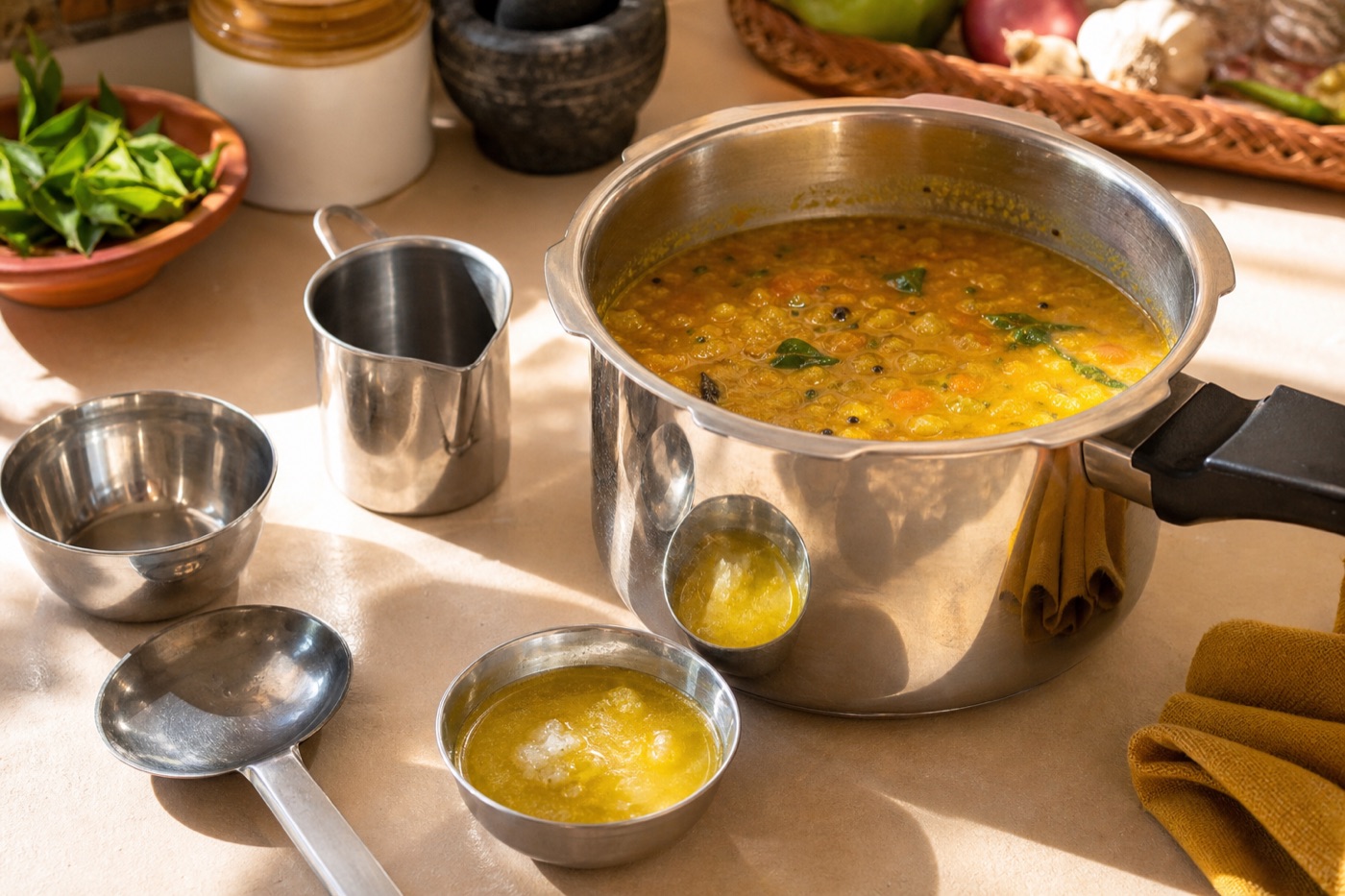
- Why Indian home food is tricky to count
- Step 1: Measure your kitchen once
- Step 2: Learn a handful of base values
- Step 3: Use the “whole pot” method for curries and dals
- Step 4: Track the oil your household uses
- Step 5: Write it down as you eat
- Shortcuts that keep it simple
- The bottom line
The simplest way to count calories in home-cooked Indian food is to measure your own katori, ladle and spoons once, weigh the main raw ingredients that go into each pot, and keep track of the oil and ghee separately because that is where most of the hidden calories sit. Then divide the pot by the number of servings. After a couple of weeks you will know roughly what your family’s dal, sabzi and rotis contain without weighing every meal.
Why Indian home food is tricky to count
Packaged food comes with a label. Home cooking does not, and a typical Indian meal mixes several dishes, each made with a different amount of oil, coconut, nuts or cream. The same “katori of dal” can be a light, watery moong dal with a teaspoon of tadka in one house and a thick, buttery dal makhani in another. That is why a single generic number is often off by 100 kcal or more.
Step 1: Measure your kitchen once
Fill each of your everyday utensils with water and pour it into a measuring cup. Write the results on a sticky note inside a cupboard door.
| Utensil | Common capacity (varies by household) |
|---|---|
| Small katori | about 100–120 ml |
| Medium katori | about 150 ml |
| Large katori | about 180–200 ml |
| Serving ladle (karchi) | about 30–60 ml |
| Teaspoon, level | about 5 ml |
| Tablespoon, level | about 15 ml |
| Steel tumbler | about 200–250 ml |
Step 2: Learn a handful of base values
Most Indian meals are built from a small number of staples. Knowing these approximate values, based on figures in ICMR-NIN’s Indian Food Composition Tables and common home recipes, gets you most of the way.
- Phulka without ghee (made from about 25–30 g atta): about 80–100 kcal
- Cooked white rice, one medium katori (about 150 g): about 180–210 kcal
- Plain cooked dal, one medium katori, before tadka: about 100–150 kcal
- Ghee or oil, one level teaspoon (about 5 g): about 40–45 kcal
- Ghee or oil, one level tablespoon: about 120–135 kcal
- Toned-milk curd, one medium katori: about 90–110 kcal
- Dry vegetable sabzi, one medium katori: about 80–180 kcal, mostly depending on oil
Our guides to roti and rice and dal go into more detail for each.
Step 3: Use the “whole pot” method for curries and dals
For dishes cooked in one pot, this method is more accurate than guessing per katori:
- Weigh the main raw ingredients. For a dal, that is the raw dal; for a chicken curry, the raw chicken; for a sabzi, the vegetables plus any potatoes or paneer.
- Measure the oil, ghee, cream, coconut or nuts that go in. These carry the most calories.
- Add up the totals using raw values (for example, raw toor dal is roughly 340 kcal per 100 g).
- Count the servings when you dish it out. If the pot fills six medium katoris, divide the total by six.
Worked example. A pot of toor dal made with 150 g raw dal (about 500 kcal), one tomato and one onion (about 40 kcal), and a tadka of two teaspoons of ghee (about 90 kcal) adds up to roughly 630 kcal. If it gives six katoris, each is about 105 kcal. Double the ghee and each katori rises to about 120 kcal.
Step 4: Track the oil your household uses
Another useful check is to look at how much cooking oil and ghee your home gets through in a month. Say a family of four buys about 2 litres of oil a month. That is roughly 1.8 kg, or about 15 g per person per day, which is close to 135 kcal each before any ghee, butter or fried snacks. ICMR-NIN’s guidance for a 2,000 kcal day allows roughly 27 g of fats and oils in total, so it is easy to see how quickly heavier cooking adds up.
Step 5: Write it down as you eat
Logging straight after a meal is much more accurate than reconstructing the day at night, when the extra spoon of ghee on your paratha and the biscuits with evening chai are easy to forget. A notebook works perfectly well. If you would rather log meals on your phone, see our guide to the best calorie counter apps in India.
Shortcuts that keep it simple
- Fix your roti size. If your rotis are always made from a similar ball of dough, you only need to work out the number once.
- Serve with the same katori. Using one katori for dal and sabzi every day makes portions far more consistent.
- Add ghee at the table, not in the pot. Spooning ghee onto your own plate lets you control and count it.
- Repeat breakfasts. If poha or idli-sambar is a daily habit, calculate it once and reuse the figure.
- Do not chase precision. A figure within about 10% is good enough for steady progress.
If counting begins to make mealtimes stressful, or you have a history of disordered eating, it is better to stop and speak with a doctor or registered dietitian.
The bottom line
Measure your utensils once, learn the values of your staples, use the whole-pot method for curries and dals, and treat oil and ghee as their own line item. Within a few weeks you will be able to look at your thali and make a sensible estimate without reaching for the scale.
Frequently asked questions
How big is a standard katori?
There is no single standard. Household katoris commonly hold anywhere from about 100 ml to 200 ml when filled level, so it is worth measuring your own once with water and a measuring cup.
Do I need to count the oil in the tadka?
Yes. Oil and ghee are the biggest hidden source of calories in Indian home cooking, at around 40–45 kcal per teaspoon. Measuring the oil for each pot and dividing it by the number of servings is the simplest approach.
How do I count calories at a wedding or a relative's home?
You cannot weigh anything, so estimate by eye using your usual katori and roti sizes as a reference, then round up for richer gravies and fried items. One estimated meal will not upset a week of careful eating.