The ICMR-NIN "My Plate for the Day" in practice
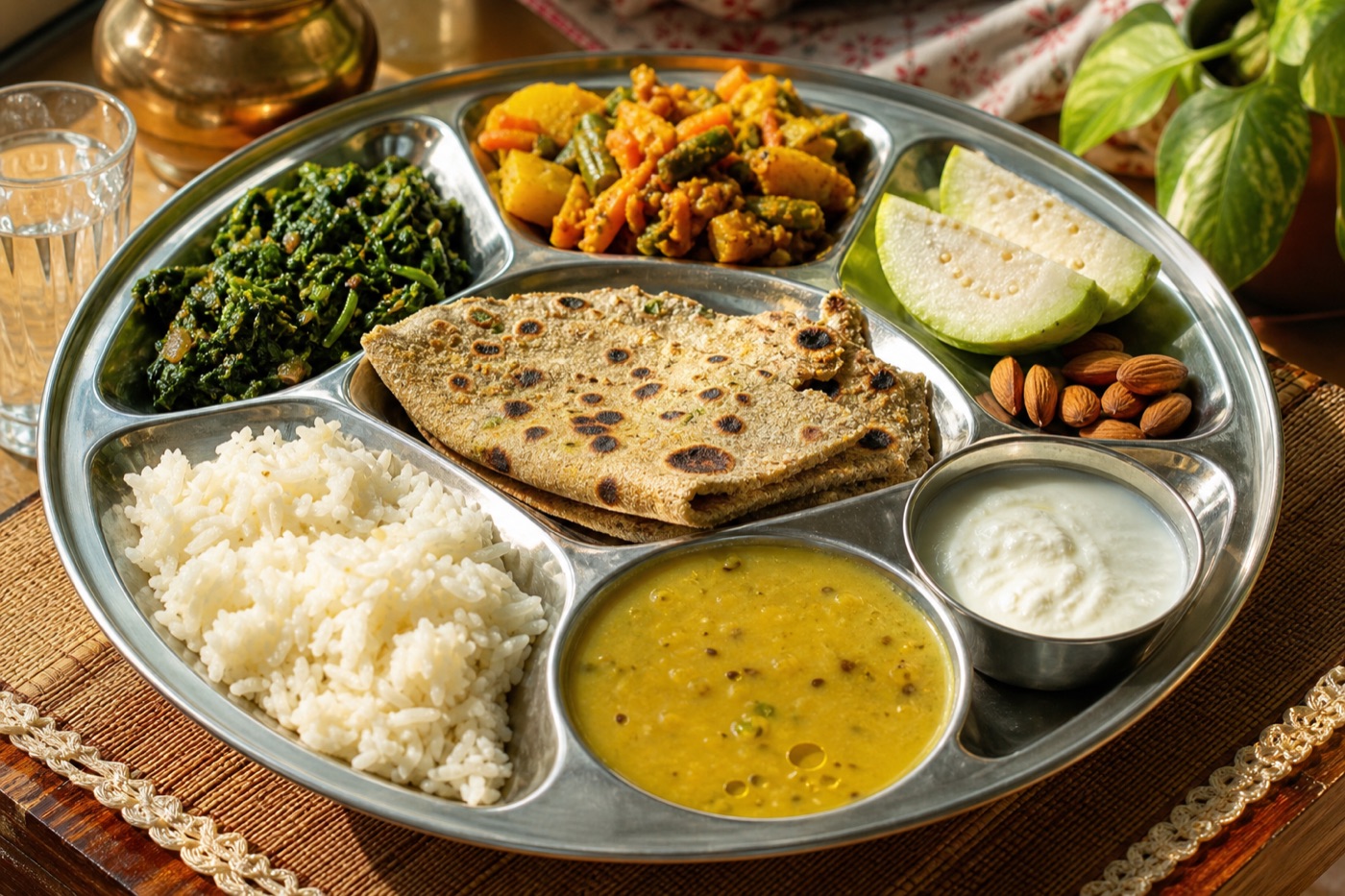
ICMR-NIN's My Plate for the Day splits a 2,000 kcal diet into food groups, with vegetables and fruit filling half the plate. Here's how it looks at home.
- The plate at a glance
- What is different from a typical Indian diet
- A sample day based on the plate
- Using the plate if your needs are different
- Other messages from the guidelines
- Common mistakes
- The bottom line
“My Plate for the Day” is the visual guide in ICMR-NIN’s Dietary Guidelines for Indians (2024) that shows how to split a day’s food across food groups. For a reference diet of about 2,000 kcal, it suggests roughly 400 g of vegetables, 100 g of fruit, 250 g of cereals and millets, 85 g of pulses (or eggs, fish and meat), 300 ml of milk or curd, 35 g of nuts and seeds and about 27 g of fats and oils. Put simply, vegetables and fruit should fill around half your plate, with cereals taking far less space than they do in many Indian meals today.
The plate at a glance
All amounts are for the whole day and, for cereals and pulses, refer to raw weight.
| Food group | Daily amount (2,000 kcal plate) | What it looks like at home |
|---|---|---|
| Vegetables, including green leafy vegetables | about 400 g | 3–4 katoris of sabzi plus a salad |
| Fruits | about 100 g | 1 medium guava, apple, orange or banana |
| Cereals and millets | about 250 g raw | e.g. 2 katoris cooked rice + 5–6 phulkas, with a millet roti in place of some |
| Pulses, eggs, fish or meat | about 85 g raw | 2–3 katoris of thick dal, or dal plus an egg or a small fish piece |
| Milk and curd | about 300 ml | 1 glass milk + 1 katori curd |
| Nuts and seeds | about 35 g | a small fistful of peanuts, almonds or seeds |
| Fats and oils | about 27 g | roughly 5–6 level teaspoons for all cooking |
The household equivalents are approximate translations to make the plate easier to picture.
What is different from a typical Indian diet
Many home diets are built around a big heap of rice or a stack of rotis, with a small katori of dal and an even smaller sabzi. The plate turns that around:
- Vegetables move to the centre. At around 400 g a day, they become the biggest group by volume.
- Cereals take a smaller share. The guidelines advise that cereals should provide no more than about 45% of daily energy, while in many homes they provide much more.
- Pulses get a proper portion. Around 85 g raw is far more than a single thin katori of dal.
- Nuts and seeds are included daily, not just at festivals.
- Oil has a ceiling. About 27 g a day for everything, from tadka to the tawa.
A sample day based on the plate
Here is how one day could look in a North or South Indian home. Quantities are approximate.
Breakfast
Vegetable upma or two besan chillas with grated vegetables, a katori of curd and a guava. This covers part of the cereals and pulses, plus a fruit and a share of milk products.
Lunch
One katori of rice or two to three phulkas, a large katori of thick dal or sambar, a katori of green leafy sabzi such as palak or methi, and a kachumber salad.
Evening
A small handful of roasted peanuts or mixed nuts with a cup of lightly sweetened chai made with toned milk.
Dinner
Two phulkas or a jowar bhakri, a katori of rajma, chana or a fish curry, a katori of mixed vegetable sabzi and a katori of buttermilk or raita.
Across the day that follows the shape of the plate: plenty of vegetables, two to three servings of pulses, milk and curd, nuts and a measured amount of oil. The cereal portion here is on the lighter side, which suits someone with lower energy needs; to reach the full 250 g on a 2,000 kcal day, add another roti or a katori of rice at lunch and dinner.
Using the plate if your needs are different
The 2,000 kcal plate is a reference, and ICMR-NIN’s figures show many sedentary women need less while active men need more. Our guide to how many calories Indians need explains the ranges. A practical way to adapt the plate:
- If you need less: reduce cereals and oil first, for example one fewer roti per meal and a teaspoon less oil a day.
- If you need more: add cereals, millets, pulses and milk rather than fried snacks and sweets.
- Always protect vegetables, fruit, pulses and dairy. These carry most of the vitamins, minerals, fibre and protein.
Other messages from the guidelines
The 2024 guidelines go beyond the plate. Among their key messages:
- Eat a variety of foods, including several kinds of vegetables and fruit.
- Keep salt to about 5 g a day and limit sugar.
- Cut down on ultra-processed foods high in fat, sugar and salt.
- Read food labels on packaged foods.
- Drink enough safe water.
- Stay physically active every day.
FSSAI’s Eat Right India campaign carries many of the same messages, such as reducing salt, sugar and oil in daily cooking.
Common mistakes
Counting potatoes as vegetables. Roots and tubers are part of the vegetable group, but leaning only on aloo means missing the leafy greens and other vegetables the guide emphasises.
Using juice instead of fruit. Whole fruit brings fibre; juice does not.
Ignoring hidden oil. Namkeen, biscuits, fried snacks and restaurant food all draw on the same 27 g budget.
Forgetting pulses at breakfast. Adding besan, moong or sprouts at breakfast makes the daily pulse target much easier to reach. Our guide to Indian breakfasts shows which options already include a pulse.
The bottom line
My Plate for the Day is a simple picture of balance: half the plate vegetables and fruit, a smaller share of cereals and millets, a proper portion of pulses or other protein, milk or curd, a handful of nuts and a capped amount of oil. Use it as a daily checklist rather than a rigid rule, adjust the cereals and oil to your own energy needs, and ask a doctor or registered dietitian for advice if you have diabetes, kidney disease, are pregnant or are planning meals for children.
Frequently asked questions
Is My Plate for the Day only for vegetarians?
No. The pulses group can include eggs, fish and meat as alternatives, so non-vegetarian households can swap part of their dal for these foods while keeping the rest of the plate the same.
What if I need fewer than 2,000 kcal a day?
The 2,000 kcal plate is a reference. If your needs are lower, the usual approach is to trim cereals and cooking oil first, while keeping vegetables, fruit, pulses and milk as close to the guide as possible.
Does the plate mean I must eat these amounts at one meal?
No. The amounts are for the whole day, spread across breakfast, lunch, snacks and dinner. The 'plate' is a picture of a full day's balance.