Calorie deficit explained, with an Indian plate
A calorie deficit means eating less than you burn. For most Indian adults, trimming 300–500 kcal a day from rice, rotis, oil and snacks is enough to start.
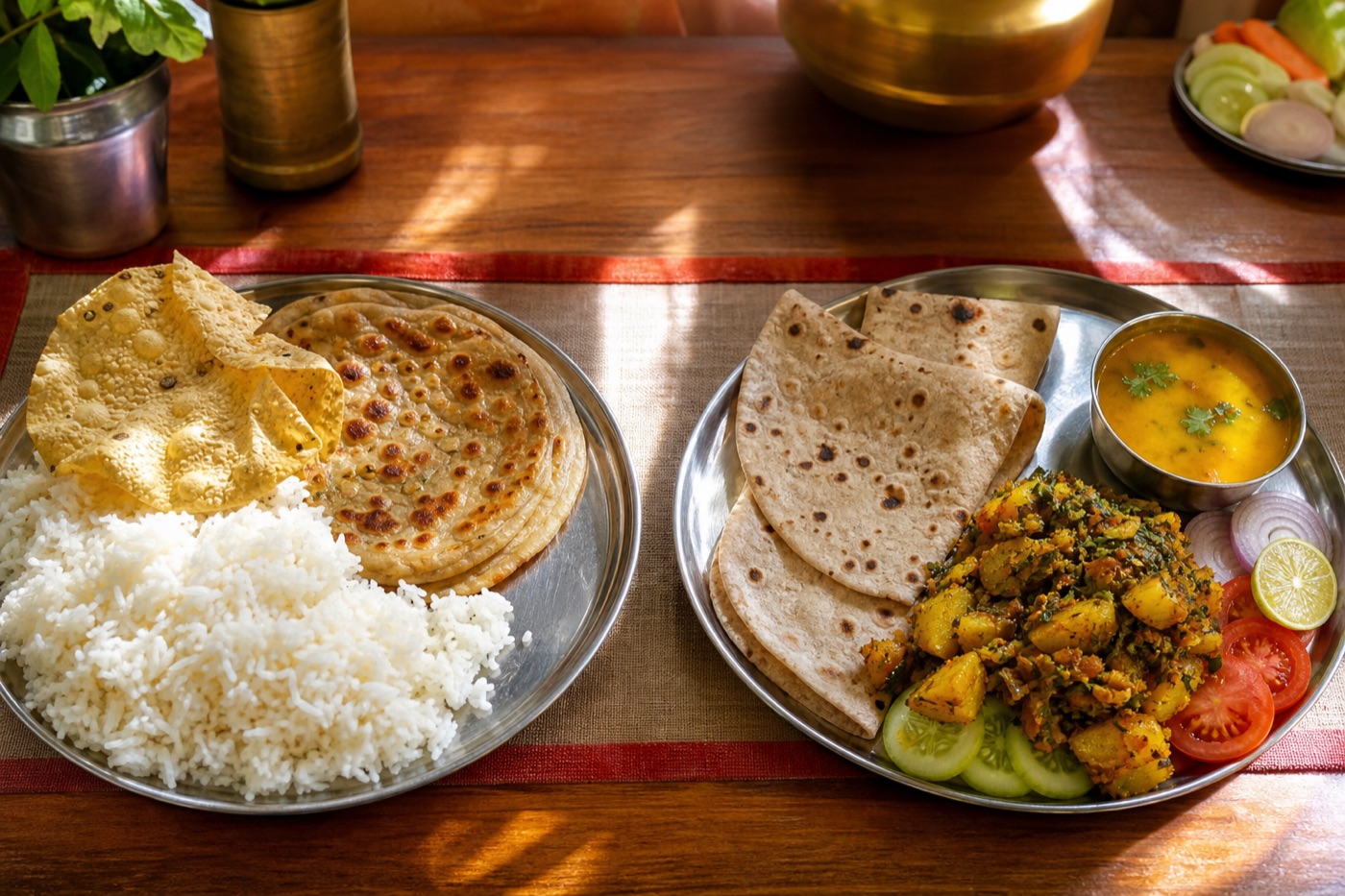
- What is a calorie deficit, in plain words?
- How big should my deficit be?
- Where the calories hide in an Indian plate
- Questions people often ask
- Track for a few weeks
- When a deficit is not right for you
- The bottom line
A calorie deficit means taking in less energy from food and drink than your body uses, so that it draws on stored fat to make up the gap. For most Indian adults, trimming about 300–500 kcal a day is a sensible place to start, and much of that can come from the usual suspects in an Indian kitchen: the extra katori of rice, the ghee on rotis, fried evening snacks and sugar in chai. A pace of around half a kilo a week is widely regarded as safe and sustainable.
What is a calorie deficit, in plain words?
Think of your body’s daily energy use as your “maintenance” level. ICMR-NIN puts this at roughly 2,100 kcal a day for a sedentary 65 kg man and 1,650 kcal for a sedentary 55 kg woman, with more for active people. Eat at maintenance and your weight holds steady. Eat less, and the difference is your deficit.
A long-used rule of thumb is that one kilogram of body fat contains about 7,700 kcal. So a deficit of roughly 500 kcal a day, kept up for a fortnight, adds up to something close to a kilo. If you are not sure of your starting point, our guide to daily calorie needs for Indians explains the ICMR-NIN figures.
How big should my deficit be?
The answer depends a lot on your size and activity, and this is where many Indian women in particular get caught out.
| Who | Approximate maintenance | Suggested daily deficit | Resulting intake |
|---|---|---|---|
| Sedentary man, 65 kg | about 2,100 kcal | 400–500 kcal | about 1,600–1,700 kcal |
| Moderately active man, 65 kg | about 2,700 kcal | 500 kcal | about 2,200 kcal |
| Sedentary woman, 55 kg | about 1,650 kcal | 250–350 kcal | about 1,300–1,400 kcal |
| Moderately active woman, 55 kg | about 2,130 kcal | 400–500 kcal | about 1,630–1,730 kcal |
A full 500 kcal cut for a small, sedentary woman would take her below 1,200 kcal, which makes it hard to get enough protein, iron and calcium. A smaller cut, combined with more walking, is the better route.
Where the calories hide in an Indian plate
Most of us do not need to change what we eat so much as how much of a few items. Here are common swaps with rough savings; pick two or three that suit your household to reach your target.
| Instead of | Try | Approx. saving |
|---|---|---|
| 2 katoris of rice at lunch | 1 katori of rice and an extra katori of sabzi or salad | 150–200 kcal |
| 3 rotis with a teaspoon of ghee each | 2 plain phulkas and more dal | 150–220 kcal |
| Restaurant-style dal makhani | Home-style moong or toor dal with 1 tsp tadka | 150–250 kcal |
| 2 samosas with evening chai | A handful of roasted chana and a fruit | 300–400 kcal |
| Sweet lassi | Salted chaas | 150–220 kcal |
| Chai with 2 tsp sugar, three times a day | Chai with 1 tsp sugar | about 50 kcal |
| Fried papad | Roasted papad | 25–40 kcal |
These values are approximate and depend on your recipes and portions.
Questions people often ask
Will I lose muscle if I eat less?
Some muscle loss can happen with any deficit, and more with large ones. Keeping protein steady at every meal, through dal, curd, paneer, eggs, fish or chicken, and doing some strength exercise twice a week helps protect muscle. Our article on high-protein vegetarian Indian foods has ideas for vegetarian homes.
Why has the scale stopped moving?
Weight can stall for a week or two because of water retention after salty food, a heavy workout, a festival weekend or hormonal changes. Over the longer term, a lighter body also burns a little less, so your deficit gently shrinks. Recheck portions, especially oil and rice, before cutting further.
Should I skip dinner?
Skipping meals tends to backfire in the form of late-night snacking or an oversized next meal. A lighter dinner, such as two phulkas with dal and a big sabzi, usually works better than none at all.
Track for a few weeks
Most people underestimate how much oil, sugar and snacking adds to their day. Writing down meals for two or three weeks shows where your easiest savings are. If you would rather log meals on your phone, our guide to the best calorie counter apps in India compares the options. Weigh yourself two or three times a week, at the same time, and compare weekly averages rather than single readings.
When a deficit is not right for you
Indian guidance uses lower BMI cut-offs than many other countries, so health risks linked to weight can begin at a BMI of around 23 and a waist size of about 90 cm for men and 80 cm for women. Even so, a deficit is not suitable for everyone. If you are pregnant or breastfeeding, under 18, have diabetes, thyroid or kidney problems, take regular medication or have a history of eating disorders, speak to your doctor or a registered dietitian first.
The bottom line
A calorie deficit is just a modest, steady gap between what you eat and what you burn. For most Indian adults, 300–500 kcal a day is plenty, and it can come from one less katori of rice, lighter tadkas, roasted rather than fried snacks and less sugar in chai. Keep protein up, stay active and give the scale a few weeks before judging your progress.
Frequently asked questions
How much weight can I lose with a 500 kcal deficit?
By the usual rule of thumb, about 0.5 kg a week, since a kilo of body fat holds roughly 7,700 kcal. Real progress is rarely that tidy, because water and digestion cause day-to-day swings on the scale.
Should I stop eating rice to lose weight?
There is no need. Rice fits into a calorie deficit if the portion is sensible and the rest of the plate has dal, vegetables and curd. Cutting one extra katori often does more good than cutting rice out entirely.
Can I create a deficit only through exercise?
It is possible but slow, and it is easy to eat back what you burn. Most people find it easier to make small food changes and add walking or yoga for health, fitness and a little extra burn.